
Company: National Film & Television School
Genre: Stealth Adventure Thriller
Engine: Unity 6
Role: Lead Developer & Level Designer
Platform: PC
Tenure: Jan 2025 - Oct 2025
About: Out Of The Shadows
Out of the Shadows is a story about a scientist wrongly framed for a crime he didn’t commit, who must escape prison using stealth to bring the real culprit to justice. It is a pure stealth-focused game inspired by titles such as Dishonored, Tom Clancy's Splinter Cell, and A Way Out.
I initially worked on this project as a Level Designer, creating blockouts for the different areas of the prison that I designed and planned. After the completion of the pre-production stage, I gradually assumed the role of Lead Designer.
Features
-
The game is a pure stealth-focused game.
-
Overcome challenges posed by guards patrolling the prison.
-
Use environmental cover while avoiding guard sightlines and hearing ranges to navigate the prison undetected.
Key Contributions
-
Launched Out of The Shadows (2025) on Steam for PC and showcased it at EGX 2025, highlighting level design, player flow, and environmental storytelling.
-
Prototyped different arenas for stealth approaches. Balanced enemy placement to control pacing and player understanding of game mechanics and story.
-
Designed the game as a linear narrative split across multiple levels, delivering approximately 30 minutes of gameplay using Unity and FMOD.
-
Collaborated with music composers, sound designers, UI/UX designer, voice actor, marketing
head and video editor to evolve the game from a basic blockout to a polished player experience.
Moodboards
Prison Art Style

Lighting of the Prison

Meeting Area of the Prison

Escape Cutscene Sequence

Level Design Breakdown


Map Layout Design
One of the first steps in my development process was to follow the game development cycle strictly. This helped me maintain a disciplined workflow while effectively tracking and managing development time. During the pre-production phase, I began developing the core concept of a jailbreak stealth game inspired by titles such as Dishonored, Tom Clancy's Splinter Cell, and A Way Out, starting with rough layouts and blockouts of the prison environment.
Blockout Design
After finalising the prison map layout, I built a greybox prototype of the level to validate scale, player navigation, stealth routes, and guard patrol paths. This enabled rapid iteration and early playtesting, allowing me to refine player flow and encounter design before moving into full production.
Stealth Design & Gameplay Integration
Guard patrol routes, vision cones, and hearing ranges were integrated directly into the greybox phase to shape player movement and stealth decision-making. I designed patrol paths, sightlines, and cover placement to create readable stealth spaces where players could observe, plan, and execute their actions strategically. Early implementation of these mechanics allowed me to test encounter difficulty, balance tension, and refine routes to support multiple approaches to each objective.
Design Analysis
The level layout was designed to promote careful observation and strategic movement rather than direct confrontation. Guard patrol routes and sightlines were positioned to create pockets of tension, encouraging players to study enemy behaviour before advancing. Multiple pathways and cover placements allowed for varied approaches, supporting both cautious and riskier playstyles. High-traffic areas increased pressure through overlapping patrols, while quieter spaces provided moments of relief to maintain pacing. This balance between tension and safety helped create a consistent stealth experience that rewarded planning and environmental awareness.
Underground Prison Section
Before

After

Figure 1. Prisoner Cell Area
The window was shifted to a single opening on the left side, creating a vantage point for players to observe guard patrols and plan their escape. This helps guide the player’s attention and control player flow, ensuring they evaluate the situation before moving into a high-risk area.
Before

After

Figure 2. Prisoner Cell Vantage Point POV
The vantage point provides the player with a clear view of their destination, while the exit sign and flickering light act as visual cues that guide them towards the escape route.
Before

After

Figure 3. Door View of the Prisoner Cell Area
The prison cell doorway serves as a secondary vantage point, providing clear visibility of guard patrols and allowing players to plan their next move. From here, multiple stair routes and a ground-floor path offer varied approaches, while pillar cover supports stealth movement and carefully timed escapes.
Before

After

Figure 4. Covers placed in Underground Section
The cover placements are strategically positioned to break guard sightlines and minimise detection, encouraging a stealth-oriented approach to movement and encounters.
Before

After

Figure 5. Cooldown Area of Underground Section
Adjacent to the underground corridor, this space functions as a cooldown area that regulates pacing, offering players a brief moment of safety and relief between high-tension encounters. An overhead exit sign serves as a visual cue, clearly guiding players towards the next objective.
Tunnel Section
Before

After

Figure 6. Tunnel Section
The tunnel section uses leading lines and environmental cues to enhance spatial readability, with overhead ventilation pipes guiding players toward the next checkpoint. Strategically placed windows provide vantage points to scout threats, while red wall accents subtly reinforce direction and progression. This area also serves as the first safe introduction to the surveillance camera mechanic, allowing players to understand the system before encountering it under pressure.
Before

After

Figure 7. Underground and Overground Intersection Area Door
The red light above the door serves as a visual cue, guiding players to the next checkpoint while communicating the door’s locked state. In contrast, a continuously flickering white light above the adjacent door draws attention to it as a viable alternative route, subtly redirecting player navigation.
Before

After

Figure 8. Intersection Area Door Wall
The vantage point establishes clear sightlines to the lever and the space ahead, enabling players to scout the environment, anticipate threats, and plan their approach before advancing.
Before

After

Figure 9. Record Room
The flickering lamp functions as a visual cue to highlight an interactable document, guiding player attention while delivering narrative context through environmental storytelling. This visual language is introduced earlier in the opening cell, where lighting similarly directs players toward the daughter’s letter, establishing a consistent and readable interaction pattern.
Before

After

Figure 10. Control Room
The space between the control room entrance and the shelf creates natural concealment, allowing players to hide and safely observe guard patrol patterns. A red light above the lever functions as a visual cue, clearly indicating it as the required interaction point to open the door. This area also serves as the first low-risk introduction to the lever mechanic, onboarding players before it is used in higher-pressure scenarios.
Before

After

Figure 11. Meeting Area
The ceiling lights and yellow floor markings establish leading lines that guide player movement and reinforce spatial readability. A continuously flickering white light acts as a visual cue, subtly pulling player attention forward and directing navigation toward the next section of the prison.
Main Cell Area
Before

After
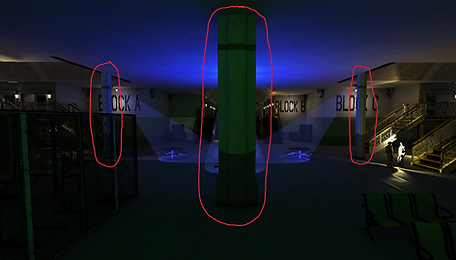
Figure 12. Main Cell Central Area
The pillars are strategically positioned to create natural cover and vantage points, supporting safer scouting and tactical decision-making during encounters.
Before
After
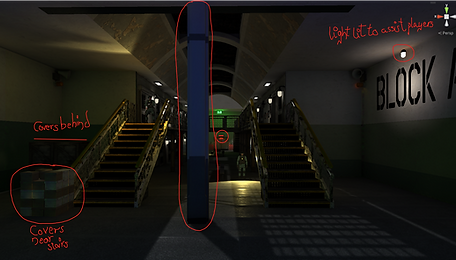
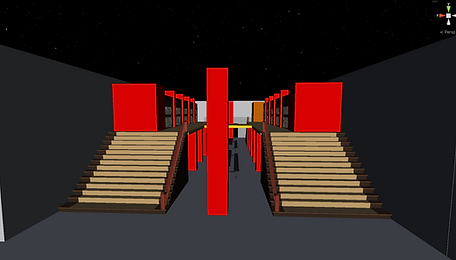
Figure 13. Block A Level Design
The three corridors in the Main Cell Area share a consistent layout to maintain readability and player familiarity. A pillar at each entrance provides natural cover and clear sightlines, allowing players to safely assess the space before advancing. Stacked crates near the left stairway create additional cover, enabling players to observe guard patrols on the upper level, while ground-level cover offers alternative stealth routes. A distant flickering red light acts as a visual cue, subtly drawing attention toward the next objective and reinforcing progression.
Before

After

Figure 14. Lever in the Control room checkpoint
The lever mechanic is introduced beforehand to onboard players in a low-pressure context. A flickering light above the lever functions as a visual cue, clearly identifying it as the primary interaction required to unlock the exit.

Figure 15. Block C Final corridor for exit
Two red lamps mark the Block C corridor as a locked path. Building on the previously introduced lever mechanic, players are encouraged to infer that activating the levers in the adjacent control rooms of Corridors A and B will unlock the door, promoting environmental storytelling and player-driven problem solving. Each corridor also incorporates dual staircases, creating multiple routes of approach and enabling varied tactical options during exploration and encounters.
Before

After

Figure 16. Some cell doors opened to provide cover for the player
Several cell doors remain open along each corridor, creating natural, thematically grounded cover for players. This solution supports stealth and tactical movement while maintaining the prison’s architectural authenticity, avoiding the use of artificial props that would break visual coherence.

Figure 17. Constricted pathways enhancing claustrophobia and tension
The narrow corridor acts as a leading line to guide player flow, while its constricted width limits sightlines and movement, heightening tension and reinforcing the prison’s claustrophobic atmosphere.

Figure 18. Lighting, fencing, and spatial blocking working together to funnel player movement and reinforce the intended route
This section uses environmental framing and lighting to clearly guide player progression. Chain-link fencing and spatial blocking restrict movement options, naturally funneling players toward the open gate as the only viable path forward. A flickering light above the gate acts as a visual cue, drawing attention to the entrance, while the blocked dead-end prevents alternative routes and reinforces the intended direction. Together, these elements reduce ambiguity and support intuitive navigation without the need for explicit UI markers.

Figure 19. Lighting and spatial blocking guiding player flow toward the gate and primary objective
Following the same design logic, this area uses environmental framing and lighting to control player navigation across a larger open space. Perimeter fencing and spatial blocking restrict traversal options, naturally funneling movement toward the gate as the primary entry point. A flickering light above the gate acts as a visual attractor, drawing attention to the correct route, while the distant building entrance functions as a landmark objective. Together, these elements support intuitive navigation through environmental cues rather than explicit UI markers.

Figure 20. Kitchen backyard Exit door
From this position, the exit door to the kitchen backyard is clearly framed, serving as a visual landmark that communicates the next objective and guides player progression.

Figure 20. Truck waiting in the backyard
The truck positioned in the kitchen backyard functions as a visual landmark and objective destination. Nearby stacked boxes create spatial blocking, restricting traversal beyond the playable area and maintaining controlled progression.
Reflection & Future Development
This project investigated how stealth-oriented level design can influence player behaviour through spatial composition, lighting contrast, and environmental guidance systems. The layout combines compressed tunnels, layered vertical traversal, and open control spaces to create a deliberate rhythm between tension and situational awareness. These transitions support spatial pacing and encourage players to pause, observe, and plan movement. Visual hierarchy, illuminated routes, and controlled sightlines were implemented to facilitate intuitive navigation while preserving immersion and reducing reliance on explicit UI markers.
A significant outcome of this work was a deeper understanding of narrative guidance and its role in maintaining gameplay readability. Colour-coded lighting, shadow gradients, and strategically placed cover elements subtly direct player flow while reinforcing stealth mechanics. Guard patrol visibility and lines of sight were structured to promote player agency, enabling multiple traversal strategies including avoidance, timing-based movement, and environmental concealment. This design approach supports emergent gameplay by allowing players to interpret risk and choose their own path through the environment.
Future development will focus on refining the balance between atmospheric lighting and clarity of interaction, ensuring that enemy silhouettes, routes, and interactable elements remain legible under low-light conditions. Expanding environmental storytelling through props, signage, and structural wear could further strengthen world-building and navigational cues. Additionally, introducing adaptive AI patrol behaviours and encounter variation would enhance challenge scaling and replayability.
Overall, this project strengthened my understanding of player psychology, stealth gameplay dynamics, and immersive environment design, informing future work aimed at creating strategically engaging and readable gameplay spaces.